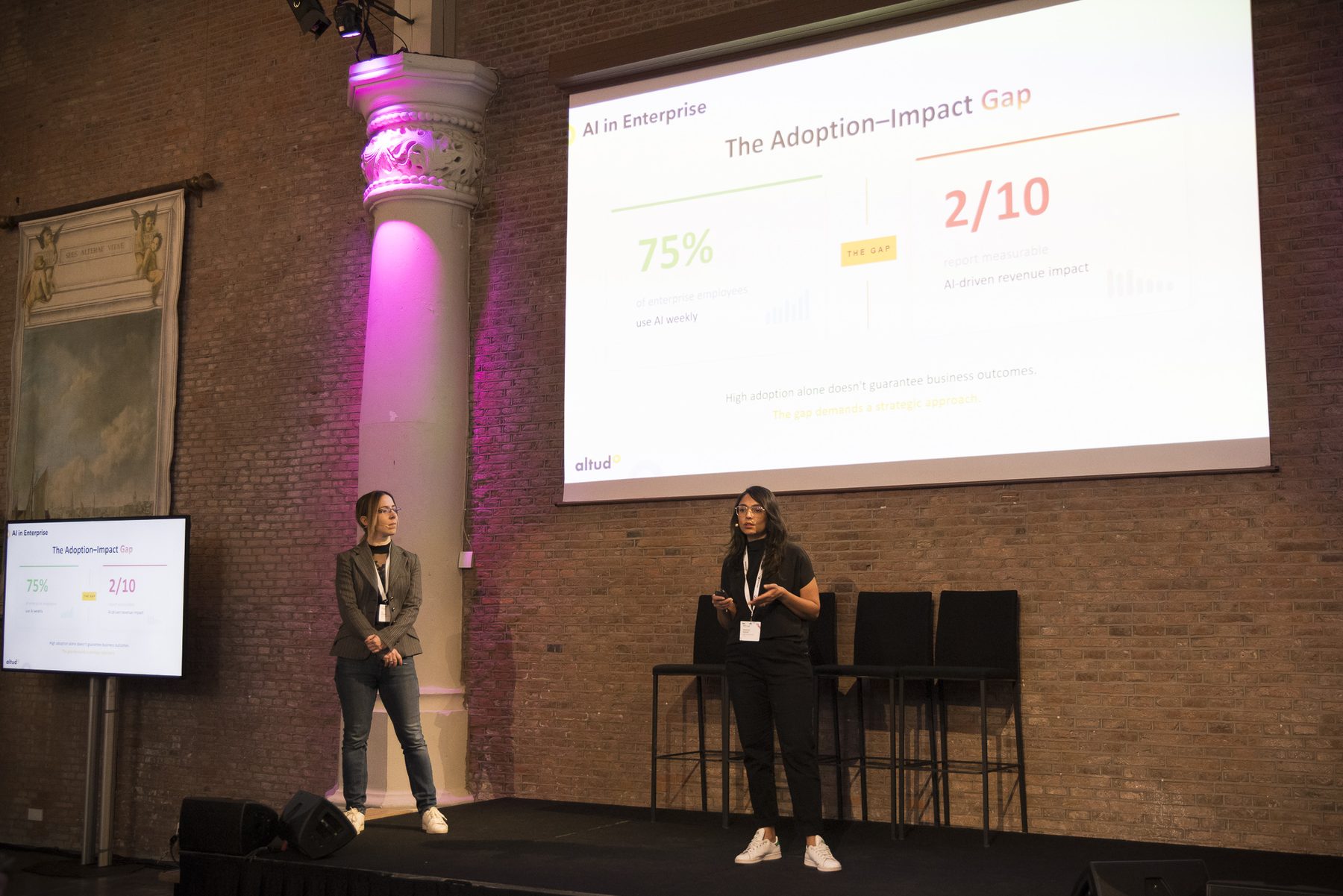
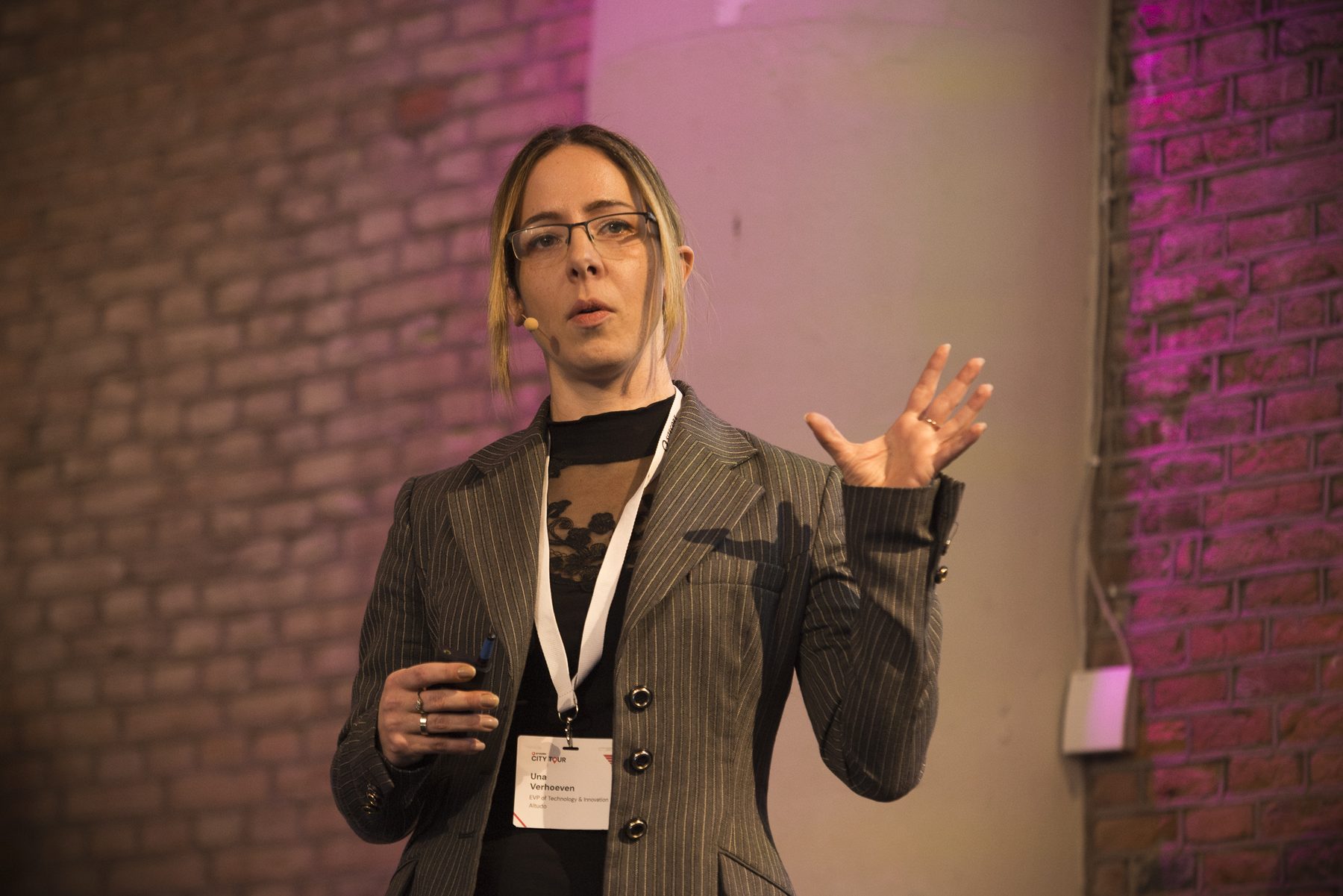
Earlier this year, Harpreet Bushell and I took the stage at the Sitecore City Tour in Amsterdam to make a case that doesn't get made often enough on an event main stage: that most enterprise AI programmes are optimising the wrong 80% of the business. Here's the argument we walked the room through.
THE ADOPTION–IMPACT GAP
We opened with the number that frames everything else: 75% of enterprise employees now use AI weekly. Fewer than 20% of those organisations report measurable AI-driven revenue impact. High adoption alone doesn't guarantee business outcomes — and closing that gap takes a strategic approach, not another tool rollout.
CUSTOMERS HAVE CHANGED FASTER THAN YOU HAVE
Before we got to AI itself, we made the point that the real shift has already happened on the customer side. Enterprises are still catching up to behaviour that changed years ago:
| Customer | Enterprise AI usage | |
|---|---|---|
| Usage | Daily | Committee-approved |
| Expectations | Instant | Roadmapped |
| Personalisation | Assumed | Planned |
| Speed | Real-time | Quarterly |
That's not a technology problem. That's an operating model problem.
THE EFFICIENCY TRAP
Most AI effort inside the enterprise is going into the 80% where everyone already focuses: build, migration, content structure, platform implementation. Useful work — but it's a cost line, not a growth line. The 20% where the value actually lives is conversion, acceleration, decisioning and revenue, and it's consistently the part organisations get to last, if at all.
Efficiency without revenue impact is just a cost cut.
WHY THE GAP EXISTS
We walked through four root causes we see repeatedly with customers:
- No clear KPIs — teams adopt AI tools without defining what success looks like, so impact stays invisible even when it exists.
- Misaligned use cases — AI gets applied to low-value tasks instead of revenue-critical workflows.
- Siloed experiments — pilots stay trapped inside individual teams and never scale to the organisational level.
- Skills gap — employees use AI confidently for basic tasks but lack the training to apply it to advanced, value-driving work.
FROM TOOLS TO ORCHESTRATION
We showed a live example of what this looks like once you move past single-tool automation: a site build and migration run not by one assistant but by a coordinated set of agents — analysing the existing site, working from templates, components and screenshots, checking Definition-of-Ready criteria for front end, back end and QA, generating prompts and stories, writing code, composing pages, migrating content, then running QA, reporting and accessibility scoring, with feedback loops back into the build step.
That wasn't one agent. That was orchestration.
A single agent is like a single employee with no manager, no process, and no accountability.
The point isn't buying more AI tools — it's building an AI operating model.
THE BUSINESS VALUE FRAMEWORK
This is the lens we told the room to apply before starting the next AI project: identify the conversion friction, quantify the cost of that friction, deploy an agent at the friction point, then measure the business outcome — not a platform metric. This framework starts with the P&L, not the platform.
A FINTECH EXAMPLE: FROM SEARCH TO BOOKED MEETING
We closed the practical section with a fintech customer journey, tracing what happens today between a prospect's first search and a booked meeting, and where an agent placed at the right friction point turns that journey into a measurable conversion gain rather than a faster page load.
A STRATEGIC FRAMEWORK FOR CLOSING THE GAP
We left the audience with four steps, in order:
- Identify high-impact use cases — map AI to revenue-critical workflows, not convenience features.
- Measure by defining clear KPIs — establish baselines and track AI's contribution to business outcomes.
- Scale through cross-functional rollout — move from team pilots to enterprise-wide implementation.
- Optimise continuously — build feedback loops that compound AI's value over time.
NOW WHAT: NEXT STEPS
- This week — audit current AI usage and map it to business KPIs.
- This month — form a cross-functional AI impact task force.
- This quarter — launch three high-impact pilots, each with success metrics defined up front.
Close the gap. Turn adoption into advantage.
Also covered on the day: Jeroen Breuer, "My Sitecore City Tour Amsterdam 2026 highlights."